Net Peptide Content vs Purity: Getting Concentrations Right
A 10 mg vial rarely contains 10 mg of peptide. How counter-ions and water dilute lyophilised material, how net content is measured, and how to correct your calculations.
Purity and net peptide content are both percentages, both appear on certificates and both are often confused. They measure different things, and only one of them should go into a molarity calculation.
Two different questions
- Purity (by HPLC): of the material that absorbs UV at 214–220 nm, what fraction is the target peptide?
- Net peptide content: of the total mass in the vial, what fraction is peptide of any kind?
A lyophilised peptide is a salt. Basic residues (Lys, Arg, His and the N-terminus) carry counter-ions, usually trifluoroacetate (TFA) or acetate, left over from purification. Freeze-dried cakes also hold some residual water. Neither absorbs strongly at 214 nm, so neither lowers the HPLC purity figure, but both add weight.
Typical numbers
| Component | Typical share of vial mass |
|---|---|
| Peptide | 60–90% |
| Counter-ions | 5–30% (higher for peptides with many basic residues) |
| Water | 2–10% |
So a vial labelled “10 mg” by gross weight might contain 7–8 mg of actual peptide, even at 99% HPLC purity.
How net content is measured
- Amino acid analysis (AAA): the peptide is hydrolysed to free amino acids, which are quantified against standards. This is the reference method.
- Elemental (CHN) nitrogen analysis: total nitrogen is measured and converted to peptide mass using the sequence’s nitrogen fraction.
- UV absorbance at 280 nm: only useful for peptides containing Trp or Tyr, using a calculated extinction coefficient.
Correcting your concentration
If a certificate gives net peptide content, the corrected mass of peptide is:
peptide mass = weighed (or labelled) mass × net peptide content
For example, 10 mg × 0.78 = 7.8 mg of peptide. Divide by the molecular weight to get moles, then by volume for molarity. Our concentration calculator does the mg/mL and µM conversions once you have the corrected mass.
When it matters most
- Concentration-response curves and EC₅₀ or IC₅₀ comparisons
- Comparing results across lots or suppliers with different salt forms
- Stoichiometric work such as binding or metal-complex studies
Weighing it yourself
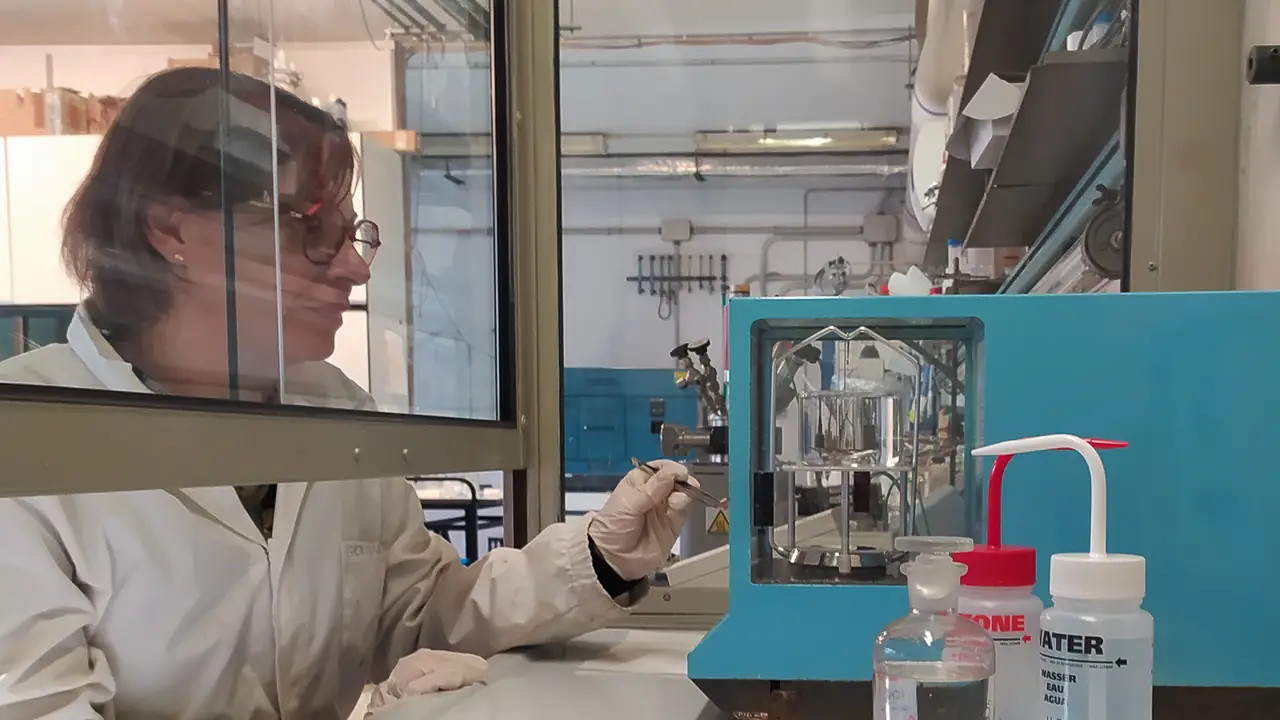
For the most accurate work, laboratories reweigh material on an analytical balance in a low-humidity environment, after letting the sealed vial reach room temperature so no condensation forms. Lyophilised peptides are hygroscopic and gain weight from the air within minutes.
For the counter-ion side of this story, read TFA vs acetate peptide salts.
For in-vitro laboratory research only. Not for human or veterinary use. This article summarises laboratory practice and published research. Nothing here is advice about use in people or animals.