Storing Lyophilised Peptides: Temperature, Light, Moisture and Time
How to store freeze-dried research peptides so they stay as described on the certificate: freezer temperatures, desiccation, light, condensation and labelling.
A lyophilised (freeze-dried) peptide is about as stable as a peptide gets. With water removed, most degradation reactions slow dramatically. Most of the damage that does happen occurs at a few predictable moments: the first hours after delivery, every time the vial is opened, and once the peptide is back in solution.
Temperature
| Condition | Typical use |
|---|---|
| Room temperature (sealed, dry, dark) | Transit and short handling periods |
| 2–8 °C | Short-term holding of sealed vials |
| −20 °C | Standard long-term storage of lyophilised material |
| −80 °C | Long-term archives and retention samples |
Move vials to the freezer on the day they arrive. A frost-free (auto-defrost) freezer warms periodically; for long-term archives a manual-defrost unit or a −80 °C freezer is better.
Moisture: the main enemy
Lyophilised peptides are hygroscopic. Absorbed water restarts hydrolysis and deamidation, and can collapse the cake.
- Let the sealed vial reach room temperature before opening. Opening a cold vial pulls humid air in and condenses water onto the powder. 20–30 minutes on the bench is usually enough.
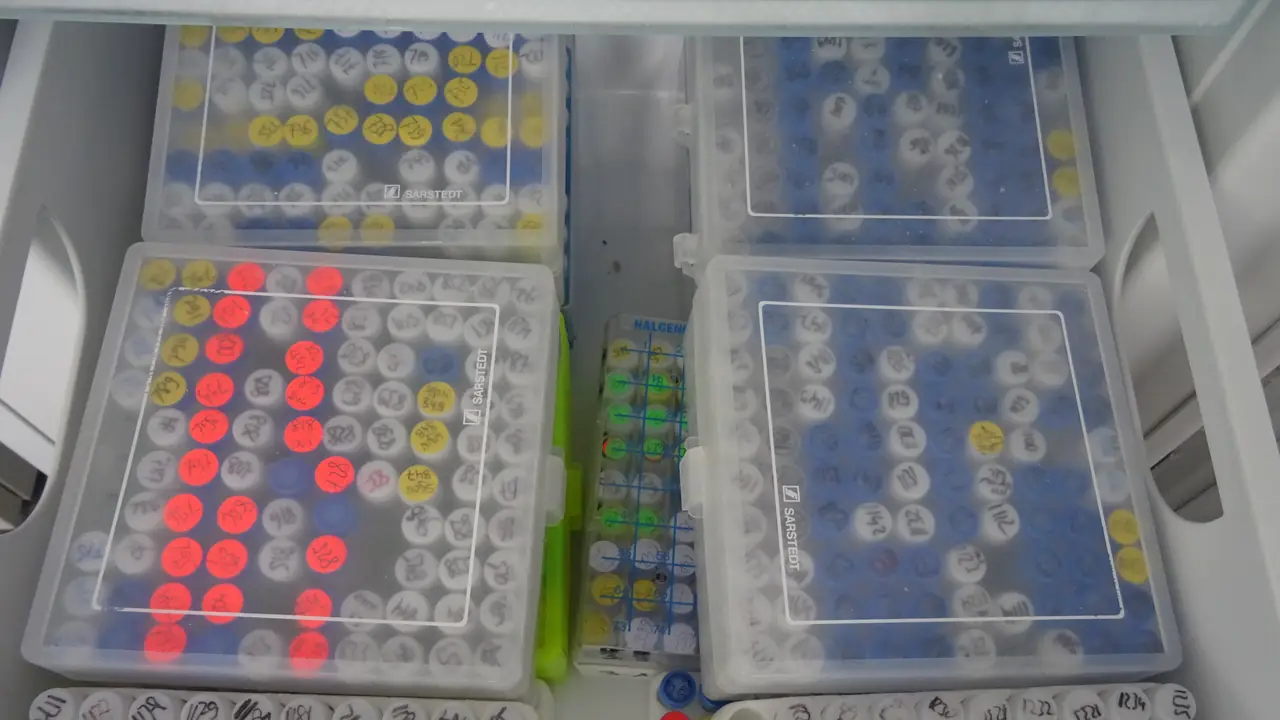
- Store vials in a sealed container with desiccant inside the freezer.
- Re-seal promptly after weighing out material.
Light and oxygen
Tryptophan, tyrosine, methionine and cysteine residues are sensitive to light and oxidation. Keep vials in their box or in amber containers, and minimise headspace exposure. For very oxidation-prone sequences, laboratories sometimes back-fill opened vials with dry nitrogen or argon.
Once in solution
Peptides in solution are far less stable than the dry powder. Good practice:
- Reconstitute only what you need (see choosing a reconstitution solvent).
- Divide the solution into single-use aliquots in low-binding tubes.
- Freeze aliquots at −20 °C or −80 °C and thaw each one only once.
- Avoid repeated freezing and thawing of the same tube; it promotes aggregation.
Peptide degradation in solution explains which sequences are most at risk and why.
Labelling
Every aliquot should carry the compound, lot code, concentration, solvent and date. When a result needs checking months later, that label is what links the tube back to its certificate. See lot numbers and batch traceability.
Signs something has gone wrong
- A collapsed, glassy or sticky cake instead of a dry white plug (“meltback”)
- Discolouration (yellowing often indicates oxidation)
- Cloudiness or particles after reconstitution in a solvent the peptide normally dissolves in
When in doubt, compare against a fresh vial from the same lot, or ask for the certificate details and the supplier’s storage guidance.
For in-vitro laboratory research only. Not for human or veterinary use. This article summarises laboratory practice and published research. Nothing here is advice about use in people or animals.