Peptide Degradation in Solution: Oxidation, Deamidation and Aggregation
Which amino acids make a peptide fragile in solution, the chemistry behind the main degradation routes, and practical steps that keep stock solutions as described on the certificate.
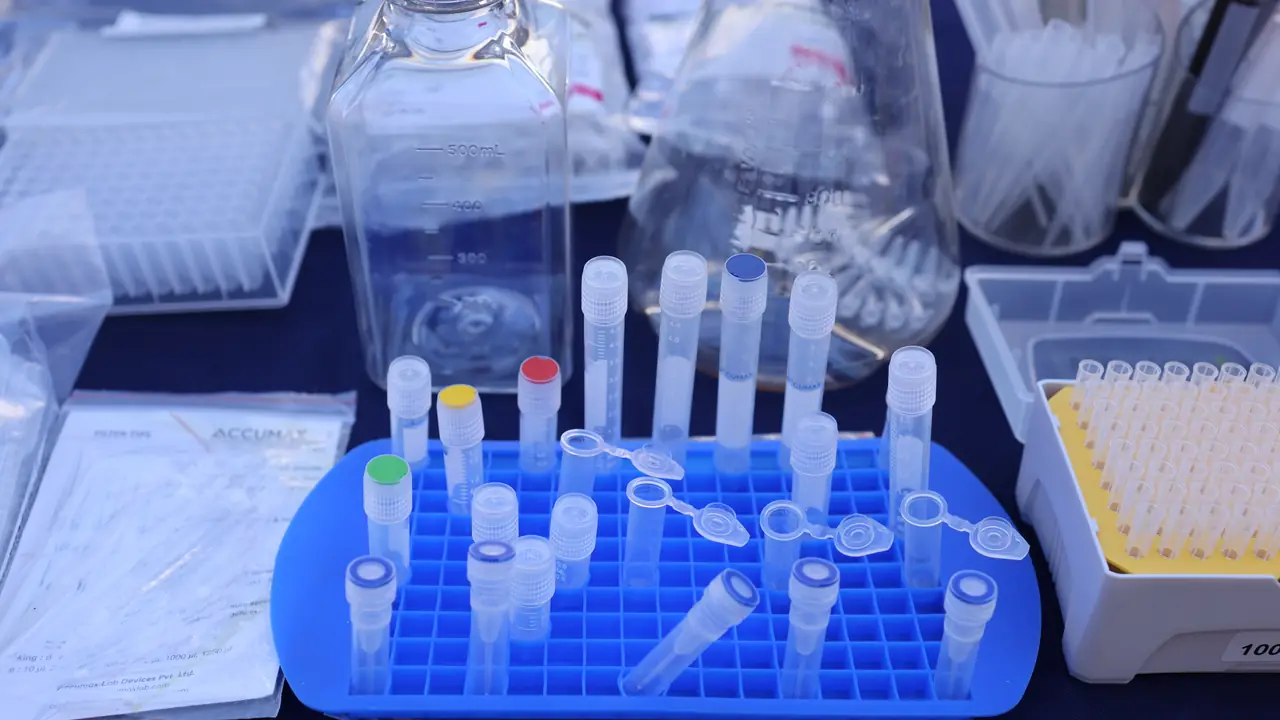
Once a peptide is back in solution, chemistry resumes. Some sequences stay intact for weeks in the fridge; others change within days. Knowing which residues are vulnerable lets you plan aliquot sizes, buffers and storage before problems appear in the data.
The main degradation routes
| Route | Residues involved | Mass change | Favoured by |
|---|---|---|---|
| Oxidation | Met, Cys, Trp, His | +16 Da (Met sulfoxide) | Dissolved oxygen, metal ions, light |
| Disulfide scrambling or dimerisation | Cys | −2 Da per disulfide | Neutral to basic pH, oxygen |
| Deamidation | Asn (especially Asn-Gly), Gln | +1 Da | Neutral to basic pH, warmth |
| Pyroglutamate formation | N-terminal Gln or Glu | −17 or −18 Da | Time in solution, warmth |
| Peptide-bond hydrolysis | Asp-Pro, Asp-Gly | Fragments | Acidic pH, heat |
| Aggregation | Hydrophobic stretches | None (non-covalent) | High concentration, agitation, freezing and thawing |
The mass changes are why LC-MS is so useful for stability work: each route leaves a fingerprint. See mass spectrometry for peptide identity.
Practical controls
Keep it cold and dark. Most of these reactions roughly double in rate for every 10 °C rise. Light drives tryptophan and methionine oxidation.
Choose pH deliberately. Deamidation is slowest around pH 3–5; Asp-Pro cleavage is fastest in acid. There is rarely one perfect pH, so match the buffer to the sequence’s weakest point.
Limit oxygen for Met/Cys-rich sequences. Use degassed buffers, fill tubes to minimise headspace, and consider an inert-gas overlay.
Aliquot once. Each freeze and thaw concentrates solutes at the ice interface and can drive aggregation. Single-use aliquots remove the problem entirely.
Use low-binding plastics. Loss to tube walls looks like degradation in an assay even when the molecule is intact.
How to tell if a stock has changed
- Re-run HPLC: new peaks near the main peak, or a broadened main peak (see HPLC purity explained).
- Check mass by LC-MS for the shifts listed above.
- Watch for haze, particles or a change in colour.
- Compare activity against a freshly reconstituted aliquot from the same lot.
Planning around stability
If a peptide is known to be fragile, reconstitute smaller amounts more often, or keep the material lyophilised until the day of the experiment. Storing lyophilised peptides covers the dry-powder side.
For in-vitro laboratory research only. Not for human or veterinary use. This article summarises laboratory practice and published research. Nothing here is advice about use in people or animals.