Choosing a Reconstitution Solvent: Sterile Water, Bacteriostatic Water, Acetic Acid or DMSO
A laboratory guide to dissolving lyophilised peptides: matching the solvent to the sequence, calculating concentration, avoiding loss to plastic, and what each diluent means for your assay.
Most reconstitution problems come from choosing the solvent before looking at the sequence. A peptide’s charge and hydrophobicity largely decide what it will dissolve in. A few minutes with the sequence saves a cloudy vial.
Step 1: estimate the net charge
At neutral pH, count roughly:
- +1 for each Lys (K), Arg (R) and the free N-terminus
- −1 for each Asp (D), Glu (E) and the free C-terminus (amidated C-termini carry no charge)
- His (H) is about neutral at pH 7
A clearly positive peptide (basic) usually dissolves in water or dilute acid. A clearly negative peptide (acidic) usually dissolves in water or dilute base such as ammonium bicarbonate. A neutral, hydrophobic peptide (rich in L, I, V, F, W, M) may need a small amount of organic solvent first.
Step 2: pick the solvent
| Solvent | Suits | Considerations |
|---|---|---|
| Sterile water | Most short, charged peptides | No preservative; use promptly or aliquot and freeze |
| Bacteriostatic water (0.9% benzyl alcohol) | Multi-draw stock vials kept at 2–8 °C | Benzyl alcohol can affect some cell types; include it in the vehicle control |
| Dilute acetic acid (about 0.1–1%) | Basic or aggregation-prone peptides | Lowers pH; dilute into buffered medium |
| DMSO (minimal volume), then aqueous buffer | Hydrophobic peptides | Keep final DMSO in assays low (often ≤0.1–0.5%); avoid with Cys/Met-rich peptides where oxidation is a concern |
Always test solubility on a small portion first if the material is precious.
Step 3: dissolve gently
- Let the vial reach room temperature before opening.
- Add solvent down the side of the vial, not directly onto the cake.
- Swirl or roll; do not vortex hard. Vigorous shaking can foam and denature or aggregate some peptides.
- Brief sonication in a water bath can help stubborn hydrophobic peptides.
- A clear solution with no particles or haze is the goal.
Step 4: calculate the concentration
Concentration (mg/mL) = peptide mass ÷ solvent volume. For molar concentrations you need the molecular weight and, ideally, the net peptide content from the certificate, because a 10 mg vial is not 10 mg of peptide (see net peptide content vs purity). The concentration calculator converts between mg/mL and µM.
Step 5: protect the solution
- Use low-protein-binding tubes and tips. Short, hydrophobic or highly basic peptides adsorb to standard polypropylene and glass at low concentrations.
- Aliquot into single-use volumes and freeze. See storing lyophilised peptides.
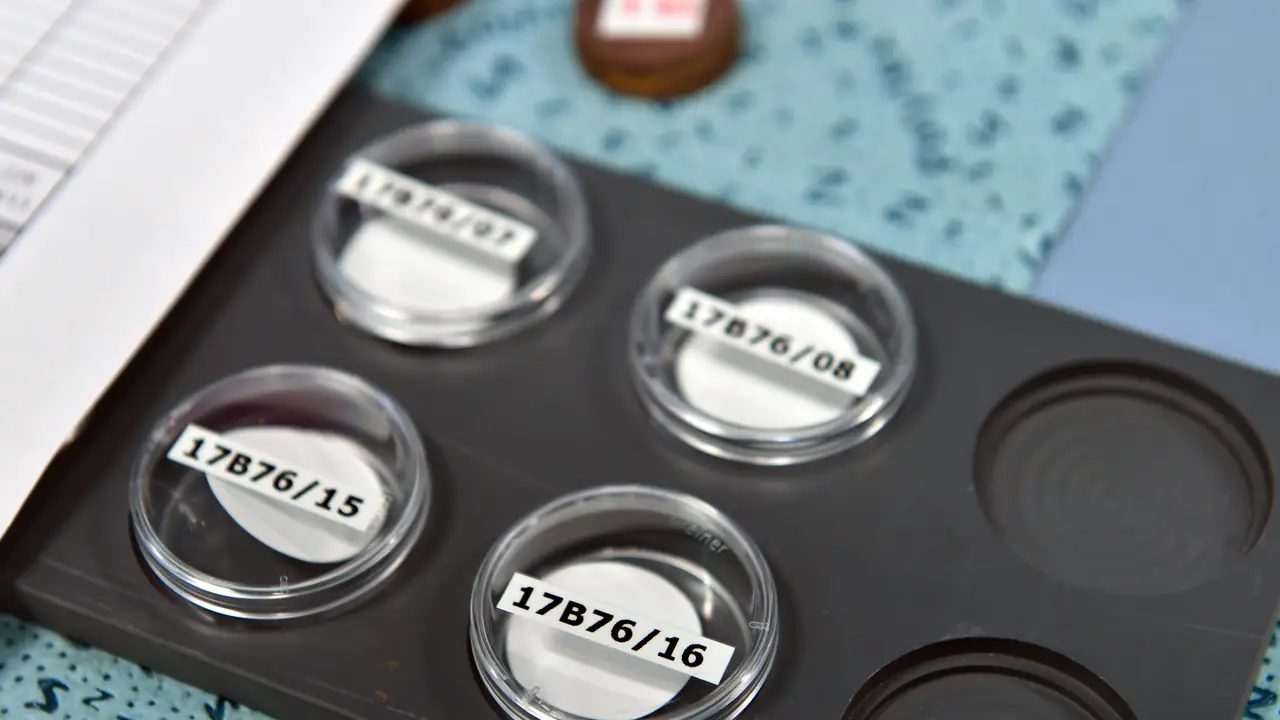
- Label each aliquot with compound, lot, concentration, solvent and date.
Match the vehicle control
Whatever you dissolve the peptide in, your vehicle control should contain the same solvent at the same final concentration. Benzyl alcohol, acetic acid, DMSO and residual TFA can all produce small effects of their own.
For in-vitro laboratory research only. Not for human or veterinary use. This article summarises laboratory practice and published research. Nothing here is advice about use in people or animals.